
Crisis - and Independence
What a small nation on the other side of the planet can teach Wales about the storm that’s coming

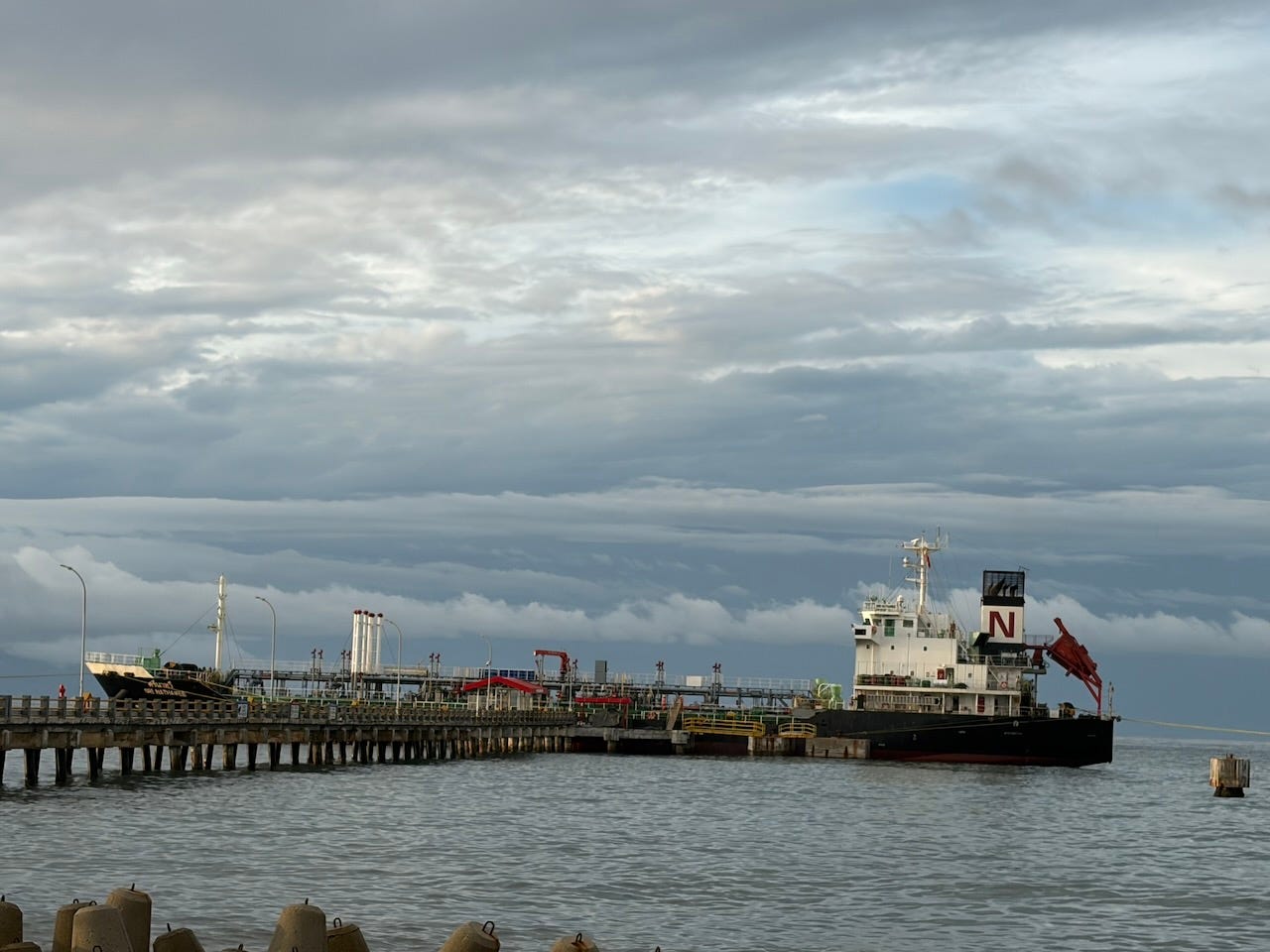
The Sri Nathawee unloading her cargo. Copyright the author, 2026. All rights reserved.
There’s a new ship anchored offshore. Over a few chilled martinis, I’ve been watching her and thinking about what she represents - for the tiny nation of Timor-Leste where I live, and for Wales.
She’s the Sri Nathawee, a Thailand-registered oil tanker: a touch under 105m long and drawing 5.8m. She can carry six million litres of refined petroleum products: petrol, diesel, jet fuel. Enough, in practical terms, to keep this small country moving for perhaps a week.
I’d guess she arrived empty, and was loaded from the Ocean Pride, a much larger vessel registered in the Cook Islands that’s been anchored further out for the last couple of weeks. The Pride, at 228m long and drawing 13.6m, is too big to come inshore to the jetty. A few kilometres along the coast sits the Angel No. 2, flagged in Panama, capable of carrying 18 million litres. Three ships, keeping our lights on for another month. Hopefully more will follow.
Here in Timor-Leste, people understand very clearly what energy means. ‘Energy’ isn’t an abstract discussion about carbon targets, quarterly growth figures or ideological positioning. Without fuel, food doesn’t arrive and the lights go dark.
That may yet happen. The Strait of Hormuz has been closed since early March. The last tankers that were already at sea when it shut have reached their destinations. No more crude is coming onto the market; no more LNG. Other producers can’t make up the shortfall. Supply falls, demand doesn’t, and prices climb. That hurts everywhere but it hurts Europe worst, because Europe doesn’t produce nearly enough for its own needs - and won’t buy from neighbouring Russia, which used to supply cheap and reliable energy.
Wales, as part of the UK, is part of Europe in this sense. The economic shockwave heading toward it, and the political consequences for the new Plaid Cymru government, will be the subject of my next article. This one is about what Timor-Leste has done to prepare, and why it matters for Wales.
Freedom is Worth the Cost
In Wales, debates about independence often feel abstract or performative. Here, it’s personal an Independence isn’t just a constitutional preference; it’s a reality tied to survival, dignity and political agency.
As I write, Timor-Leste is celebrating its national day: 20 May, the Restoration of Independence. ‘Restoration’, because East Timor first declared unilateral independence on 28 November 1975, ending four centuries of Portuguese colonial rule.
Freedom lasted nine days.
On 7 December 1975, neighbouring Indonesia invaded; on 17 July 1976, Timor-Leste was formally annexed. The Timorese remained free in their hearts, though, fighting on from redoubts in the hills, safe houses in the towns, and tiny diplomatic missions at the United Nations and in Lisbon. They eventually won their country back in 2002, after several years of UN administration. An independent truth and reconciliation commission estimated more than 102,000 and 183,000 confirmed deaths directly connected to the resistance struggle, in a population that started the occupation at around 650,000. Add in disappearances and those who were displaced and never found again, and you get up to around 292,000 people who were free for nine days and were never seen again. 45% of the population.
So ‘freedom’ means something here. ‘Independence’ isn’t a slogan. Behind those words sit the memory of torture and mass rape, of neighbours and relatives who disappeared, of watching friends and family starve, of years of fear.
And it means something else too: the practical capacity to act in your own interests in a global crisis.
When the Oil Stops Flowing
Once the US and Israel launched their unprovoked assault on Iran in late February, it was obvious that global fossil-fuel supplies were going to be disrupted - and energy is everything. Without energy you don’t have an economy.
The Timorese government acted quickly. It allocated US$168.8m to buy 80 million litres of fuel as a buffer. The Sri Nathawee, the Ocean Pride, the Angel No. 2 - and the Singapore-flagged Bliss a fortnight ago - are presumably the result.
Independence hasn’t made Timor-Leste a paradise. At 5,743 square miles it’s 72% the size of Wales. With 1.4 million people, it’s about 44% of the Welsh population. Its physical geography makes internal travel difficult. Its oil and gas fields are depleted; the sovereign wealth fund built from them is being drawn down faster than anyone is comfortable with. Its economy is small and profoundly unbalanced. In the first three months of 2025, for example, the country’s exports amounted to 96 tonnes of coffee, and effectively nothing else.
But sovereignty has its benefits.
Timor-Leste is a member of the World Bank’s International Development Association, which lends to small economies on generous terms. It belongs to the Forum of Small States, the Singapore-led grouping of UN members that looks out for the interests of mini-states. Most importantly, it is now in ASEAN: an eleven-member bloc which, together with China, Japan and South Korea (ASEAN+3), is already the world’s largest and fastest-growing (PDF) market.
That membership has produced tangible outcomes. Timor-Leste will benefit from POWERR Asia - Partnership on Wide Energy and Resources Resilience - a US$10bn Japanese fund for member-state energy security and emergency fuel purchases. It feeds into ASEAN’s wider work on collective energy resilience. Brunei has agreed a cooperation deal on investment and energy. Vietnam has pledged that Timor-Leste won’t run short of rice, its staple food.
None of this means there aren’t problems. Pump prices for petrol and diesel are climbing, although the government has introduced controls to steady public confidence. Domestic electricity prices haven’t really moved yet. One small sign of where things are heading: yesterday I visited the local dealership of a well-known Chinese e-bike manufacturer, and they had almost sold out of stock in a fortnight.
What’s worth a Welsh reader’s attention is this: ASEAN, unlike the EU, isn’t ideological. It doesn’t promote a model of governance or a specific set of values. It exists to improve its members’ domestic wellbeing. Most of its members carry recent memory of European colonisation, and they aren’t inclined to be told what to do by outsiders, especially against their own self-interest. So Japan is buying Russian crude, sanctions notwithstanding. Before the US blockade of Iranian ports, Malaysia and the Philippines had negotiated safe-passage arrangements with Tehran. Combined with regional oil and LNG production, ASEAN may ride out the coming shock rather better than Europe.
The Challenge for the Welsh Government: Responsibility without Power
The Strait of Hormuz is still closed. The economic consequences are now bearing down on Wales like a tsunami, and it will fall to Rhun ap Iorwerth’s new Plaid Cymru government to cope with them. The Welsh government didn’t cause this storm and couldn’t have avoided it whoever had won the election. But it will own the response - the cuts, the choices, the priorities - and through that response, intentionally or not, it will reshape the argument about what Wales is and what it could be.
That’ll be the subject of my next piece.
Thanks Emlyn, great to see your articles here, I’m new to Substack. Thanks for sharing Claire (from AC87-89)
Couldn't be more timely a comparison Emlyn. Eerie silence here in NE England next to the Scottish Border. Youngest grandchild is about to sing for younger Ceredigion at Eisteddfod yr UrddLlantwd (Llandudoch), near I just learn the bluestone area, ref. your recent journey through Wales and history.
Up here, the diesel delivery vans run too and fro and old people must drive to medical appointments. Wishing you well for rice and beans and local veg. Yesterday I was looking online at Chinese e-bikes!