Crisis and recovery
A power cut prompts thoughts on personal and national recovery from crisis

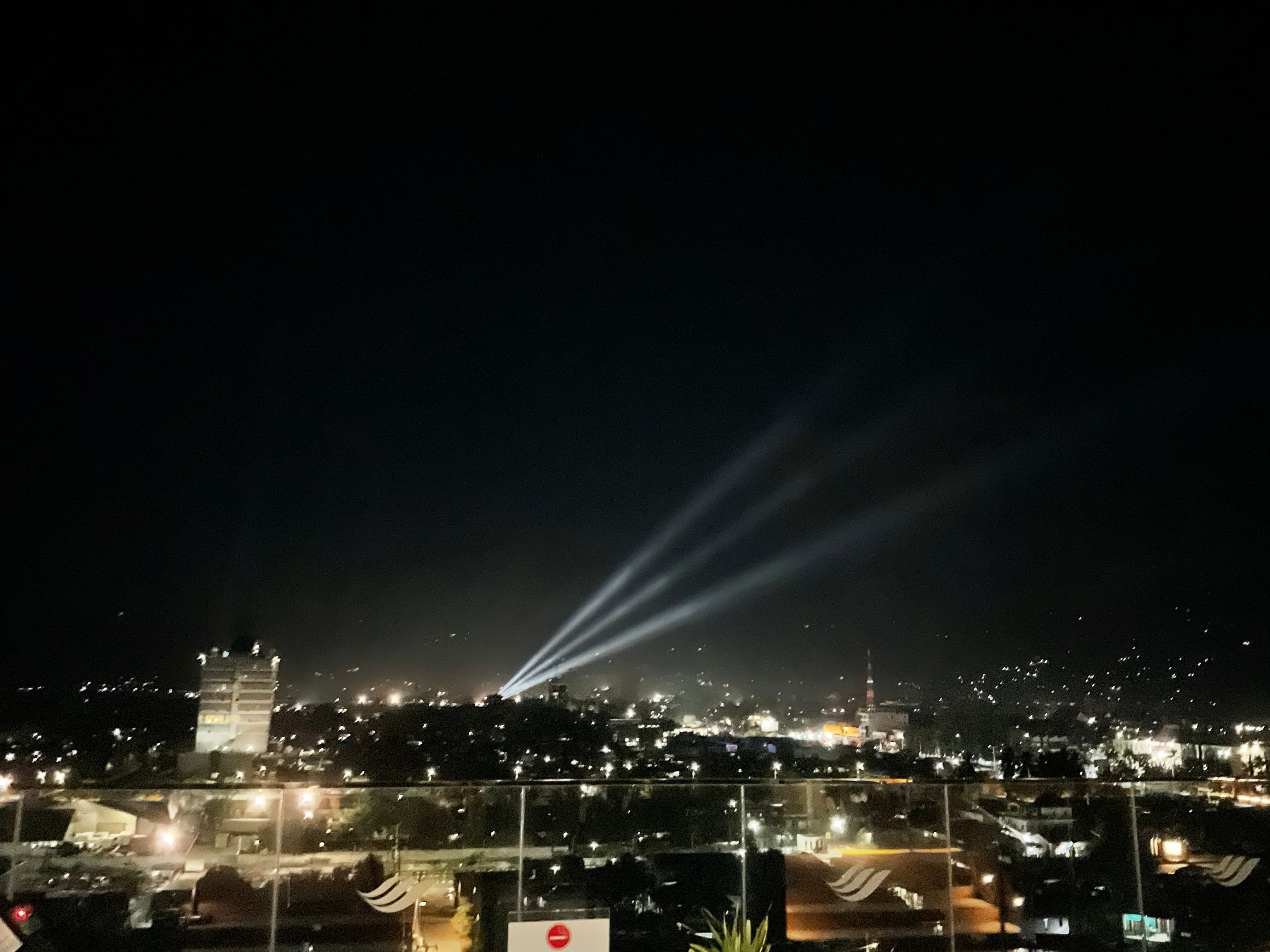
I'm typing this on battery power. The power went off across the city hours ago without warning; the water soon afterwards.
Apparently, it's a regular occurrence; it means they're doing maintenance on the grid somewhere. Now I understand why so many adverts for rental apartments mention that the building has a backup generator. But it goes to show how things can change unexpectedly - and how fragile the systems underlying a complex modern society can be.
Living in a developing country makes this a bit more obvious: it's easier to get glimpses under the covers. We can't take these systems and processes for granted - and have no doubt, they are becoming increasingly fragile and insecure across the West.
We need to have plans in place for life in a transformed situation.
That's true for individuals, it's true for organisations, and it's true for nations.
Fortunately, very smart people have been thinking about this for a long time, and have developed tools to help with our planning.
This week, that's what I want to talk about. It may seem to be a change in direction from previous posts, but I wouldn't say so. It's just that this is a bigger topic, so I'm going to break it up a bit by first of all explaining my thought processes as I apply them to my own life. Then, in an upcoming post, I’ll apply them to nations: Timor-Leste and Wales.
But it is, frankly, a topic that everyone needs to be urgently considering - including you, reader.
If you've missed it, a number of world leaders have started to say openly what I've been saying for a long time: the world has changed. Keir Starmer was blunt: “The world as we knew it has gone. Old assumptions can no longer be taken for granted”. You can't get clearer than that: the post-WW2 global order is coming to an end.
As I discussed in my last article, complex societies need deep reserves of knowledge and technical experience. They also need constant supplies of resources to keep the system running. Food, energy, manufactured goods - and, lately, a supply of people with the necessary skills.
Western countries long ago lost the ability to produce sufficient food and raw materials themselves. Lately, that's extended to the ability to produce industrial and consumer goods. Nor do we produce enough people educated in productive industrial fields, or trained in essential trades.
We've been able to make up for this by buying or hiring them from the rest of the world, encouraging their best and brightest to come to our countries. When that failed, we were able to compel them give us what we needed using our financial and economic power - or military power, when push came to shove.
But that time is passing. You've surely noticed that everything's getting more expensive. The global market is getting more competitive, and we're not doing so well any more. The countries which supply the resources, the manufactured goods, the services and the people are finding other, more affluent or more motivated customers in new markets who are outbidding us.
So whether you're living on benefits and worrying about them being cut, or a moderately-successful mid-to-late-career professional, you need to be urgently making plans for your future, because the economy and society we live in are likely to undergo a transformative change in the not-too-distant future, simply because we no longer have the means to keep them running.
There's no way to predict how events will unfold - but we can confidently predict that both government assistance and stable middle-class careers are going to become much scarcer.
I ask myself: am I being alarmist or paranoid here? Checking your thinking against reality is critical, in what businesses describe as environmental scanning. Are things really so bad?
Well, the big clue is the Iberian blackout, when Portugal, Spain, and parts of France completely lost power for around ten hours. It ended up not being too bad: it was in warm countries in spring, and it didn't last too long. What's troubling, though is that nobody really knows, as I write this, what caused it, since the grid wasn't under heavy load.
Then there's the Heathrow blackout in March: massive disruption and economic loss caused by a transformer fire... and by the absence of any backup systems. Like so much of the UK's critical infrastructure, that transformer was apparently very old. In fact, it turns out that the average age of transformers in the UK's national grid is 63 years. It's not comforting to consider that replacement transformers take a very long time to obtain and, due to rising material costs, are now 400% to 900% more expensive than they were only a few years ago.
Keep that in mind as we consider that in January of this year, low temperatures meant that the UK's national grid came very close to being overwhelmed, with uncontrolled blackouts across the country a real possibility. Imagine a prolonged nationwide blackout in the middle of winter, caused by a Heathrow-style failure of one or more ancient but irreplaceable transformers... No heat, no light, no water, no shops, no transport…
Let's add to that the way the NHS was paralysed when a critical software system went down, and the fact that pharmacies routinely run out of prescription medicines. I've written about that elsewhere. I could add more examples, and I'm sure you can too.
So no, my evaluation is that I'm not being alarmist. There are clear and consistent signs that the United Kingdom is no longer able to maintain its current levels of social and economic complexity. Again, I can't predict how the process of enforced simplification will play out, only that it seems inevitable - and there’s a growing number of commentators arguing that the UK is toast. Worse, I agree with the analysts who argue that our political classes simply don’t have the skills to turn things around and are instead resorting to magical thinking:

So how do we plan for what we can see coming?
On a personal level, I described in my first post how and why I've left Wales and rejoined the Welsh diaspora. The writer John Michael Greer often advises his readers to "collapse now and avoid the rush". In other words, get used to a simpler life now through choice, rather than wait until it's forced upon you. Well, my plans and expectations for the future were well and truly collapsed, repeatedly, by unexpected crises. In that respect, I've gone through the turmoil of collapse rather earlier than many of my peers.
I left because those crises severely damaged my health in almost every way: physical, mental, emotional and financial.
(I will say, though, that if anything it's served to strengthen my spiritual health, but that's a discussion for another time and place).
I need to consolidate and rebuild, and I couldn't do that if I stayed in Wales.
An opportunity appeared in East Timor, and I took it. I acted to regain momentum and agency, rather than reacting to events I couldn't control.
Now that I'm here, I'm taking stock, regaining my strength... and planning. In Wales, I was tied to a particular situation - caring for an elderly relative - and so wasn't free to act; I simply had to absorb the damage as best I could. Now that I'm no longer bound by that commitment, the worst thing I could do would be to just drift, driven hither and thither by events like a rudderless ship.
So, I'm determining my goals. What future situation do I want to be in? What does that mean, in terms of income? Lifestyle? Work? Personal and professional autonomy? Location? That's a work in progress. I do have answers to those questions - but new information provokes new thinking, and Timor Leste is already suggesting that there are unexpected opportunities here to be investigated.
Of course, once I set my goals, there comes the question: how do I get there? What's the overall path, and how do I break that down into manageable, achievable steps? Is it a direct path, or is it going to have to be a more zig-zag route involving changes of direction, consolidation, and then moving off for a new stage on the journey?
OK, so now I have a sense of where I want to be, and how I could get from here to there... but how do I make it happen? Any project, especially a project on the scale of re-inventing my life, needs resources.
Here, I can use the concept that there are six types of wealth. You'll find this expressed in different ways, but I like the version expressed here. In this model, 'wealth' is composed of physical, intellectual, spiritual, financial, social and time aspects. It's not just money!
So I might evaluate my own situation as being cash-poor but with assets that can be released in a relatively short time which will give me a certain degree of independence, particularly if I base myself in relatively cheap countries.
Intellectually, I'm well-off. I have degrees from respected universities in a range of fields; I've got a number of useful professional qualifications; I've got skills and a heck of a lot of global experience. The value of these varies according to the market: I can't legally use my hypnotherapy training in some countries, for example, while my global experience sadly has no market in inward-looking Wales. I’ve a record of writing very niche blogs which built useful networks and established enduring friendships. I’ve published articles and written books. So, this area’s looking good.
Socially, I'm poor: my networks are getting old and scattered. I'm building new ones online which will hopefully translate into real-world friendships and professional contacts.
My health has been compromised by the stress of being a carer, but not permanently: with attention and effort, I'll be able to restore myself to excellent health. That process is already underway.
Time-wise, the move to Asia has been demanding, and getting established has needed twelve-hour days or longer. That’s not sustainable, of course, but things are rapidly becoming more manageable as I find my feet, and I anticipate having sufficient time to develop my various projects.
Now that I've audited my resources, I can start planning my roadmap.
One step is to evaluate potential stepping stone locations to see how good a fit my skills, knowledge and qualifications are for the needs of various potential markets - and what I need to acquire that will be useful for my intended destination.
Another is the extent to which I'm going to need to leverage my social assets for things like references, advice, and favours. Since this is a weak area for me, I'll need to get help from strangers in the form of work and goodwill - and that means I need to work on my marketing, in the form of a persuasive personal narrative and the ways I can get it heard by the right people.
So that's my personal response to unexpected crisis, within the larger context of a declining society. I'm by no means bowed or defeated, because the process gives me a roadmap - and hope for a better future. I certainly believe it’s still possible for me to become wealthy (the link is to an excellent article by Naval Ravikant, which I encourage you to read).
What the process can do for me personally can also be done for you, reader. It can be done for Timor Leste and for Wales. That's where I'll be taking this thought process in a future article.
Ah, the power has come back on. Good!
In the distance, the sound of massed drums is thundering out of the local Islamic school. Here, in Timor-Leste, every school has its own marching band. They're practising for the 20th of May: Restoration of Independence Day. They gained independence from Portugal, lost it again to Indonesian conquest, and fought a bloody resistance until they got it back. It just goes to show that resilience counts: even the deepest crisis can be endured and we can rebuild our lives.
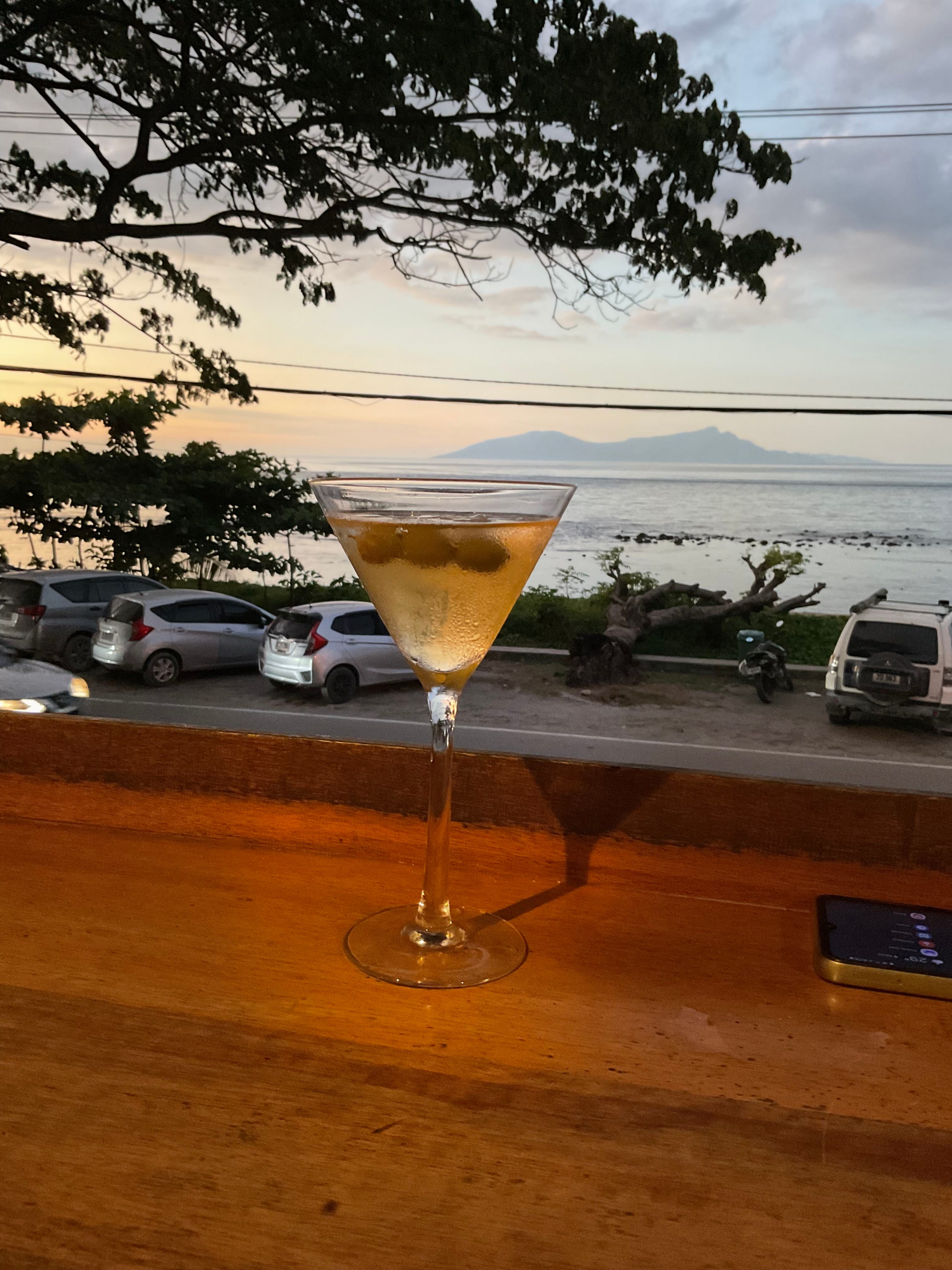
And for me, at least, it certainly helps to sit down in a beautiful tropical sunset with a well-chilled dry martini...