
Towards the Green Desert
From Lampeter to Tregaron, I follow Gawain’s path into the Green Desert, through theology, memory, and the heresy of free will.

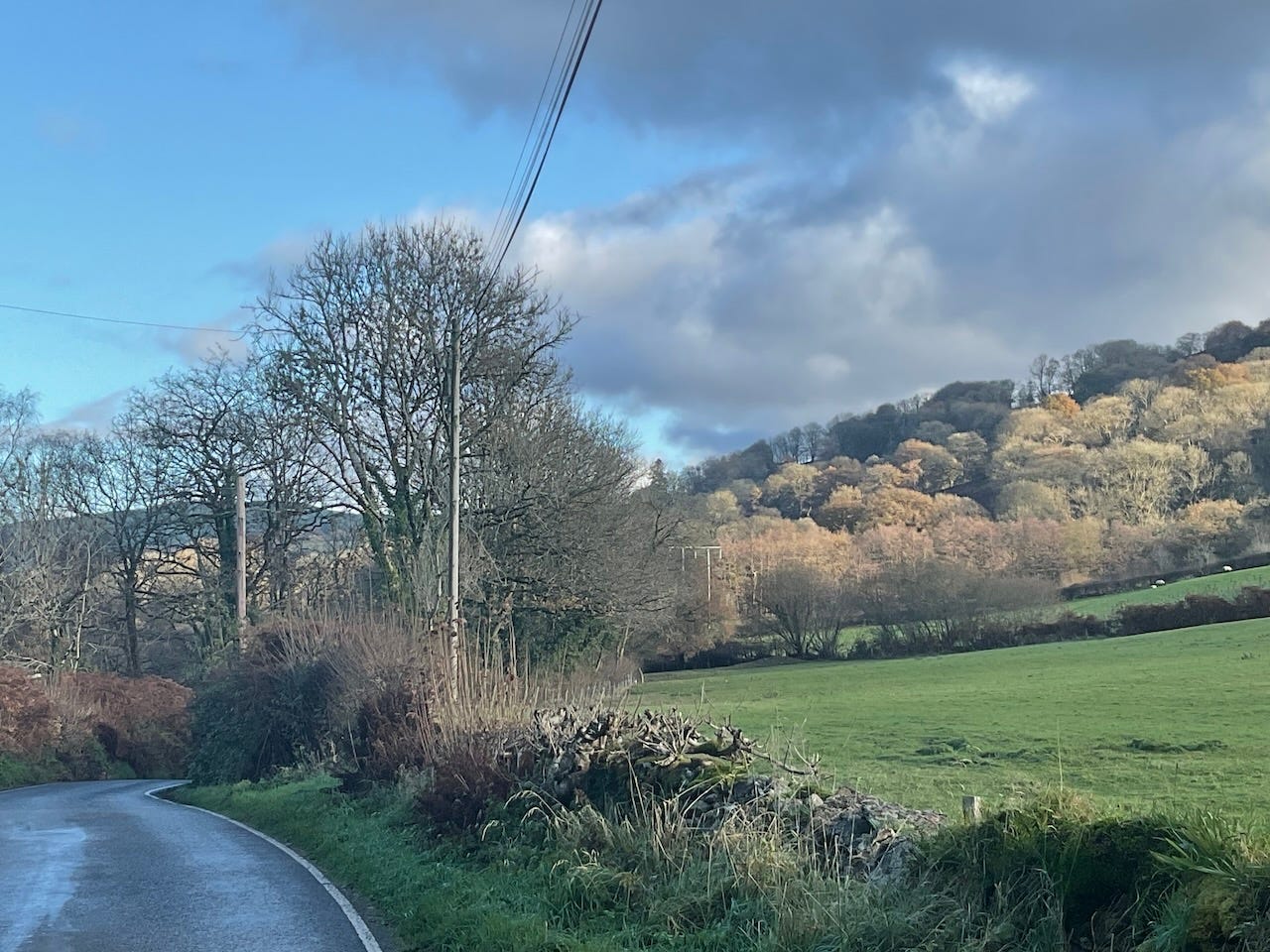
Towards Tregaron 1. Copyright the author, 2025. All rights reserved.
Route: Llanbedr Pont Steffan / Lampeter > Tregaron Tue 28 Nov 2023
Towards the Green Desert
To fulfil his wager, Sir Gawain must find the Green Knight or, as the latter called himself, the Knight of the Green Chapel. But who is he?
The Knight refuses to give his name. If he did, he says, Gawain, Arthur and the knights of the court would know his place and his kin. There’s an echo here of Crach y Ffinnant, Owain Glyndŵr’s personal bard and wizard, and his decades-long refusal to give his name.
The only clues given to Gawain are that the Green Chapel lies six days’ journey away, and that the people who live nearby will know of it.
It’s not much to go on. Gawain’s quest has to be led by geography, then. Arthur’s court contains knights from all over Britain, but none of them know where the Green Chapel lies. It must, therefore, be found far away from where most people live.
By now, Gawain has traversed the Otherworldly Preseli mountains, littered with the stones raised by a long-forgotten culture in honour of beliefs we no longer know. He’s passed through the magic-drenched, spiritually-independent land of Emlyn, and Is Coed (Beneath the Woods). Now he passes through Gwynionydd, heading for the Green Desert of Wales: the Cambrian Mountains, where there are few roads and few inhabitants.
On the edge of the Desert is the market town of Tregaron. To get there, Gawain must pass through another market town: Llanbedr Pont Steffan (the Church of Peter by Steven’s Bridge), known generally as Lampeter.
The Scholars’ Town
I catch the electric bus from Carmarthen and, a couple of hours later, disembark in the centre of Lampeter and start walking out of town, south to the hamlet of Cwmann. It’s a bright morning, the cold winter sun bright and low in the near-cloudless sky.
On the edge of town, I pause for a moment outside an empty shop. Once, and for many years, this was the location of Hag’s Record Store - but Hag Harris, a local institution, sadly passed away a couple of years ago.
Lampeter and I have a history. It’s not just a market town: it’s where the third university in England and Wales was founded back in 1822. Only Oxford and Cambridge are older (Scotland and Ireland have old universities of their own, of course).
Language and Renewal
Back in 1993, I was in some trouble. I’d graduated in the summer of 1992 with a decent degree from a respectable university but my timing was appalling. The British economy was in a recession, and there were simply no jobs to be had.
Office jobs, at least. I wound up getting full-time work behind a bar. A year later, I’d saved some money, but still had absolutely no idea what I wanted to do with my life. The economy was improving, but a new cohort of graduates were arriving. The competition for jobs was still ferocious.
I decided to enrol on a CELTA course. If I couldn’t find work in Wales, well, I would teach English and travel the world.
This happened to lead to an over-the-hedge conversation with my neighbour about learning languages, in the course of which she mentioned an intensive summer school for beginners in the Welsh language. Organised by the federal University of Wales, it was held on the campus in Lampeter.
Well.
I wanted to travel the world... but I wanted to learn Welsh even more. So I dropped out of the CELTA, spent the summer in Lampeter, studied hard, and met great people. By the autumn, I’d established myself in my journey into speaking Welsh, and the ancient language and culture of Wales. I was also broke and unemployed again - but it all worked out in the end...
Towards Tregaron
From Cwmann, a quick left-hand climb and a side turn into Cellan Road, the B4343, which will take me all the way to Tregaron. The land before me is largely flat, emphasising the looming bulk of the Green Desert’s foothills in the distance. I’ll be walking up that dark barrier to get to my rest tonight.
The going is easy, through beautiful country. The road winds slowly upwards through fields and wooded valley slopes. The colours are vivid in the intense sunlight, bright green and blue held apart by the soft browns and oranges of the trees. As I approach Cellan, the banks of the road are lined by these living sentinels, amongst whose branches tiny birds - wrens? - flitter.
I pass through Cellan, past its church, and on to the hamlet of Llanfair Clydogau. Outside the village hall, there’s a sign advertising an upcoming “Christmas Lunar Market”, while a printout inside a plastic envelope, taped to a signpost, points the way to “Ffasiwn ar y Fferm” (’Fashion on the Farm’). There’s some interesting interactions between languages and cultures going on here... I learn later that, according to census figures, 87% of the people here speak Welsh - though fewer than half were born in Wales. There’s something here that’s driving language shift in favour of Welsh; it would be interesting to know what that is.
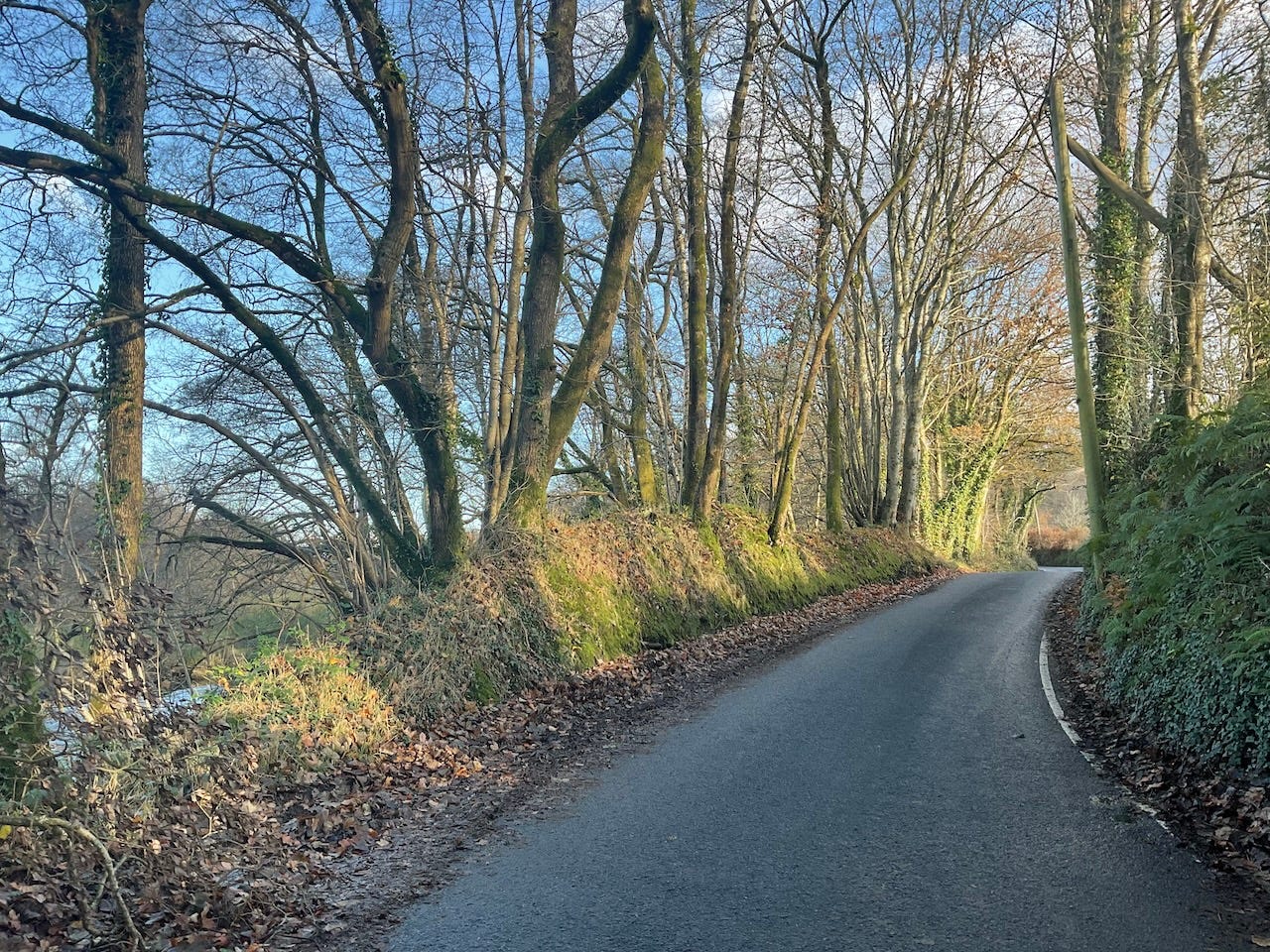
Towards Tregaron 2. Copyright the author, 2025. All rights reserved.
The going is easy, but it’s also been long - and I’m becoming very tired now. What’s more the weather is changing as the wind picks up and dark clouds fill the skies. The most physically-demanding part of today’s journey, the hard climb up to the plateau where Tregaron lies, is still ahead of me, and it looks like I’ll be doing it in the rain.
I stagger into Llanddewi Brefi and discover, to my great joy, that there’s a public bench. I pull on my waterproofs and sit down for a rest.
Saints, a Heretic, and Two Oxen
This little place seems remote and far from the controversies of the world, but it was here, midway through the sixth century - around the year 545 - that bishops and abbots from across Wales (which, you’ll recall, was much larger then than it is today) gathered to discuss a pressing matter: the theology of Pelagius,
Pelagius, a Celtic British thinker, had died over a century before; for most of his lifetime Britain had still been Roman. He argued that the soul’s fate depended entirely on our own actions. In his thinking, entry into Heaven was guaranteed - unless we chose to exercise our free will and reject God’s benevolence. In 415, the Church of Rome had instead accepted the views of Pelagius’s great opponent, Augustine of Hippo, who argued that every soul is tainted by the Original Sin inherited from Eve, and that entry to Heaven could only be obtained as a divine gift, regardless of how we lived our lifes.
Clearly, however, the British remained unconvinced. This was the time of the British Arthur, of the struggle against the invasion and settlement of the Saxons, and of the Christianity brought by the Romans against the pagan gods being imported by the heathens in their longboats.
Dubricius, a saint and bishop based in what would become Gwent and Herefordshire, decided to call a synod to restore Augustinian orthodoxy to the British church. Paulinus, a hermit based in Carmarthenshire, advised him to invite a minor figure, a Ceredigion-based abbot called David, to participate. Dubricius, for whatever reason, held the meeting in the village of Brefi, on the edge of the Green Desert.
‘Brefi’ derives from ‘bref’, to bellow, and it comes from a tale about Hu Gadarn, a name from ancient myths now mostly lost, who is supposed to have been connected with a plough and two oxen. It was Hu’s oxen who supposedly dragged the monstrous Afanc from its watery lair in the Preseli mountains so that it could be killed. And it was here, in this village, that Hu’s oxen hauled the stones to build a church. The route led over a steep hill. One of the oxen, laden with rocks, died in the attempt; as it died, it let out a great bellow. So strong was the call that a pass opened up, allowing the remaining ox to deliver its load.
A Miracle
Here, David spoke so eloquently against Pelagius that the entire gathering was won over. It was here that David performed one of his miracles, when the flat ground beneath his feet rose up to form a mound from which he could be heard more easily. Dubricius was so moved that he resigned as the Bishop of Caerleon in David’s favour. David later moved the see to Deheubarth, to what is now known as Tyddewi, or Saint David’s, in Pembrokeshire. The village of Brefi, where I now sit, became known as Llanddewi Brefi, ‘Dewi’ being a Welsh form of ‘David’.
Faith and Free Will
There are echoes here of my quest. To the author of Sir Gawain and the Green Knight and his Welsh audience, Caerleon was Arthur’s base; Gawain had strong associations with Pembrokeshire. Centuries after David’s speech, the works of Pelagius were still read and his arguments still influential. David’s new seat in Pembrokeshire had become a major destination for pilgrims, whose passage through the wild and lonely Green Desert was protected by the Knights Hospitaller - who we’ll be discussing at greater length before too long.
The ground does not rise beneath my feet, and I have no ox to open an easier road for me. I pull my pack back on, and step along my way.
After Llanddewi Brefi the land starts to rise and open up. I walk past barn conversions showing an influx of money from elsewhere, up past working farms and fields full of sheep.
Through Wind and Rain
I’m getting really tired now. I pass a farmhouse and keep on climbing. There are sheep in the field to my right; one is on the ground, and appears to be dead. I can see someone moving around in the farmyard; I call, trying to attract his attention, but it seems he can’t hear me. Should I go back and tell him? I’m too tired, and I can’t face climbing this hill again. I push myself onwards.
I pass over a small ridge and into a dip. There’s a brook here, and it’s clearly been raining upstream because the waters have risen and the road is completely flooded. There’s no way onward without wading through it.
As I contemplate how I’ll get through a large four-wheel drive car pulls up next to me. “Want a lift through?”, calls a woman’s voice. You bet I do.
I pull off my pack and clamber in. There are two women inside, both English. There’s an age difference: mother and daughter, perhaps? They moved here to raise horses. We chat. I’m going to Tregaron? So are they. Can they take me the rest of the way, they ask? My determination to walk the full distance crumbles in the face of my fatigue, and I gratefully accept the offer.
An Elephant and Ale
They drop me outside the Talbot Hotel, where I’m staying the night. Supposedly there’s an elephant buried here, a visitor who came with a circus and never left. After a wash and a change, I settle down in the stone-flagged bar and enjoy a fantastic meal washed down by a great dark beer. I get chatting to the people on the next table, a couple who I guess are in their sixties. They’re English, and have a farm nearby. Later in the year they’re getting married in this hotel. Things they mention lead me to suspect it will be a neo-pagan ceremony, though they don’t say so explicitly and I decide not to ask.
Eventually, I haul myself away from the drowsy heat of the cast iron woodburner, and head to my bed. Tomorrow I’ll be crossing the great Bog of Tregaron.
That debate was a big moment in a hinge time. Not for the last time in Wales, I guess. The poetic metaphor of 'story' has come over the hill to lend weight to history, a breath of a song. Gawain travels far over continent and centuries, revisits knowledge with legends?