
When the Tower Falls
A walk to Owain Glyndŵr’s ruined home becomes a reckoning with grief, honour and the quiet question of who we are when everything we relied on is gone.

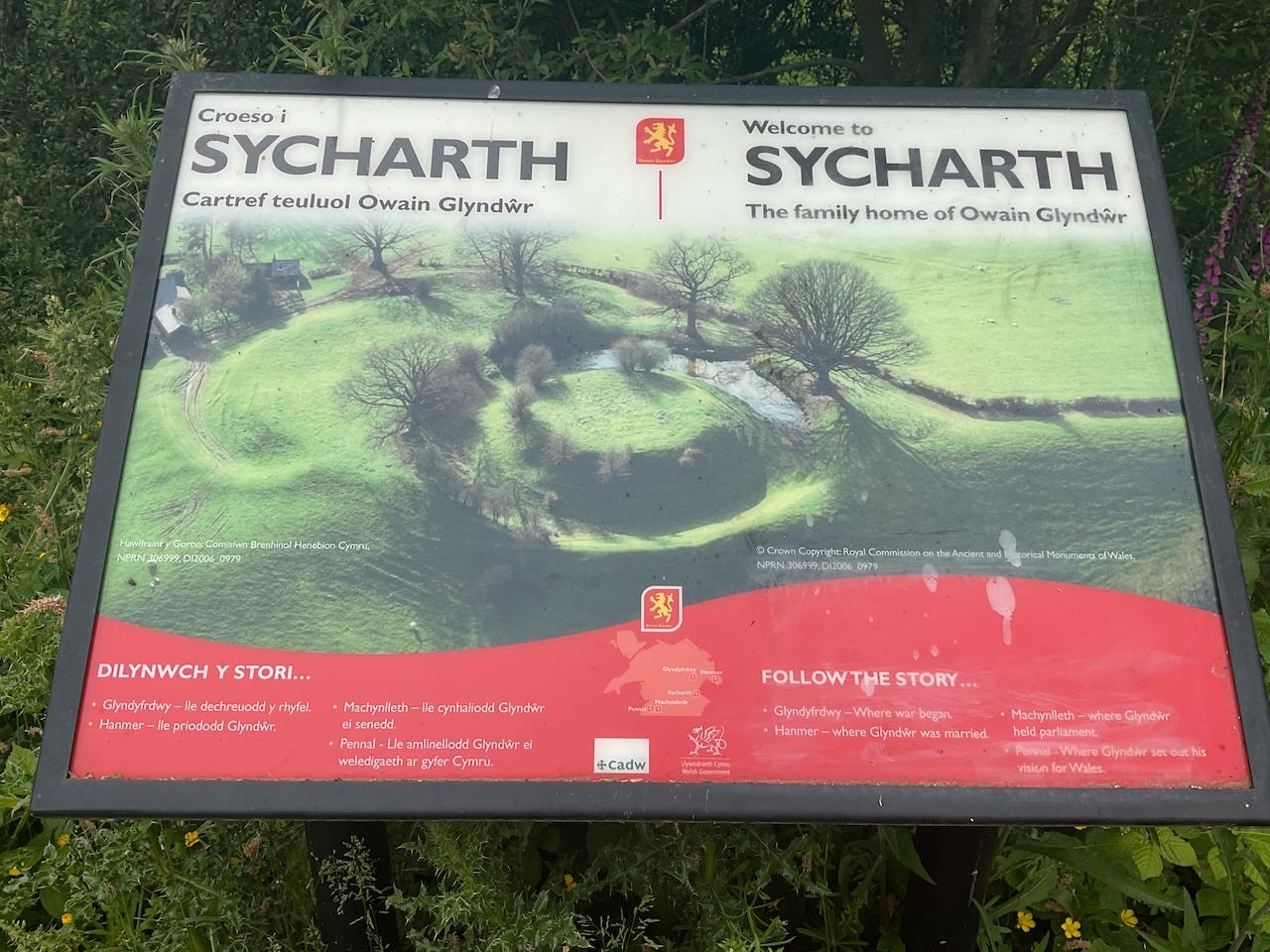
Sycharth Information Board. Copyright the author, 2025. All rights reserved.
Route: Oswestry to Sycharth and back. Monday 3rd June, 2024.
The Tower Falls
As I write this in late 2025, I’ve recently been exploring divination techniques. Divination was, after all, one of the skills a pencerdd, or master poet, of the Welsh middle ages was expected to master.
I’ve been using the Chinese Yi Jing, better known as the I Ching, for many years - ever since I was an undergraduate. I’ve had very good results from doing so - though, of course, it’s not always been what I wanted to hear. More lately, as I’ve been immersing myself in Welsh history and traditions, I’ve been drawn to discovering methods from the western tradition. One, geomancy, was widely used across Europe at the time we’re exploring in this project: it would have been very familiar to the Gawain poet, and to Owain Glyndŵr. Another, the Coelbren y Beirdd, is similar to runes. It was developed by Iolo Morganwg from who knows what tradition or inspiration - but it works, and works well.
The most well-known, of course, is the Tarot. I used it for a while during my university days, but put it aside as I focused on the I Ching. One of the major arcana has been appearing repeatedly in my readings: The Tower. The Tower depicts a high tower shattered by a lightning bolt, its inhabitants plummeting to the ground as the walls fall. It represents the collapse of a system, the shattering of certainties, the end of the world as we knew it.
This doesn’t have to be a bad thing.
The Children Open The Way
All of which seems appropriate as I sit in the bus station in Oswestry. Where’s my bus? I see one with the right number, but it’s not at the main stands and is full of uniformed schoolchildren. I spot another walker, a man in his forties dressed for the Offa’s Dyke Path, looking just as perplexed as I am.
The penny drops: the bus is chartered for the school run but, since it’s on the timetables, probably takes the public as well. I walk over to the driver, who confirms my theory. I buy a ticket, and sit down at the front of the bus, the kids and their chattering, their feuds and romances, behind me. Shortly afterwards, the other walker boards.
I get off half an hour later in the village of Trefonen (the village of the ash trees). This is one of many access points to Offa’s Dyke, the national footpath roughly following the great earthwork raised by Offa, king of Mercia, to demarcate the lands he claimed from those of the Welsh to the west. In Welsh, its name is Clawdd Offa - remember that, because clawdd - in the sense of an embankment marking a boundary - will be significant later in our tale.
Off the Edge of the Map
My world is collapsing.
For four years ago, soon after the covid-19 lockdowns ended, I’d found myself unexpectedly responsible for looking after an elderly relative. It’s been a traumatic, emotionally exhausting role - and financially exhausting as well. It involved constant struggle and the sacrifice of the dreams I’d had for my own future when I’d returned from China in late 2020. I’d come to define myself through that role.
And now it’s over. I’ve finally, after many setbacks, succeeded in setting up an arrangement in which my relative is being cared for, and their interests protected, by professionals. I’m not needed any more.
I should be relieved. I suppose I am. But life is suddenly empty. So is my bank account, or at least, that’s getting close. I’ve been living on savings for five years while I did the right thing by my relative. I don’t regret a moment, or a penny of it: my own sense of personal honour and duty (anachronistic concepts, I’ve learned) wouldn’t have allowed me to do anything else. But I’m an anachronism in other ways: a man in his 50s who’s been abroad for too long, who doesn’t have professional contacts in Britain any more, who has now a five-year gap in his CV. Nobody wants to give me a job. All of my former foundations for my sense of identity have crumbled away, and the gap is increasingly being filled with whiskey.
My Way is Blocked
This is all filling my thoughts as I progress along the lanes out of Trefonen. The path leads through a field - and here, I meet an obstacle. The path continues over a stile on the far side, but there’s a herd of cattle standing around it. Fortunately, there aren’t any calves, or I might be in real trouble. Even so, I’m not going go to try to walk amongst them: it’s uncommon for walkers to be killed or injured by cattle, but it does happen when they’re spooked. I’m in no mind to risk it.
I wait for a while. The herd gradually disperses across the field, but a hardcore half-dozen or so stubbornly stay next to the stile. I move cautiously towards them. They aren’t going anywhere. One of them moves towards me, trying to work out whether I’m a threat. I retreat to the field boundary, which turns out to be a stream lined by chest-high nettles, the mud churned up into a mire by the cattle. I press my back against a tree. The cow comes up to me. It starts trying to eat the sleeve of my waterproof jacket. I shoo it away, and the whole half-ton of cow seems to leap backwards in shock, all four hooves off the ground at once. It stands there, and I’m afraid that it’s going to butt me... but it just stares and, eventually, wanders away. Slowly, the others do too, not convinced that I’m a threat but not wanting to be too close.
Excellent. I move towards the stile. Something in the mud snags a foot and, before I can help myself, I’ve fallen to my knees. The oozing mud soaks my trousers and fills my boots. Never mind. I’m out of the field, and into the next. The path takes me to another narrow road, and after that it’s just tramping along the lanes. The high hedges largely obscure any views. I’m left to my thoughts.
Treason By Proxy
It’s strange to consider that Glyndŵr’s rebellion should never really have happened. Owain Glyndŵr was a well-respected man; affluent, widely-respected, thoroughly immersed in Welsh tradition and culture, and thoroughly integrated with both the Anglo-Norman Marcher elites and with the royal court. He was a patron of culture, and he was a fighting man - which is what caused the rebellion.
Richard II had been a great friend to the Welsh. His usurper, Henry IV, was suspicious of them, just he was suspicious of many Marcher lords, simply because they were far too independent for his liking - but he wasn’t actively hostile to them. However, when Henry seized power in 1399, one of his closest and most trusted allies was an English Baron: Reynold Grey, the 3rd Baron of Ruthin in the March. Grey’s lands bordered Glyndŵr’s, and the two men had been in dispute for years over the ownership of land.
Henry, like his predecessors, needed fighting men to garrison his fortresses on the Scottish border. These men were raised from levies, who served for a season or two before returning home. Glyndŵr had served there decades earlier; now, as a landowner, he was ordered to raise a levy of armed men and take them to join the muster of new royal forces to serve in the border force. His written instructions were given to Grey, who was supposed to pass them on. He didn’t - so Glyndŵr and his forces didn’t turn up to the muster that he didn’t even know about. Grey, at the royal court, accused him of treason and of being in rebellion against the King. With Richard, Glyndŵr might have had a fair hearing. With Henry, Grey’s close friend, there was no hope.
Lightning flashed; the Tower fell. Glyndŵr’s previous existence came to a crashing end. Condemned as a traitor, Glyndŵr decided it was better to be hung for a sheep than a lamb, and became a rebel for real. He declared himself the Prince of Wales, and called the Welsh to arms against English rule. The rest is history.
A Place of Ease and Welcome
The road is sweeping upwards now, as I cross a small bridge over a tumbling stream. The road’s banks are higher; this road has been in used for a long time. The occasional gate reviews a near horizon of valleys and small hills; there are no long vistas in this landscape. Ferns and foxgloves burst from beneath the hedges. In fact, the tall fronds and foxglove blossoms are my most lasting visual memory of this walk.
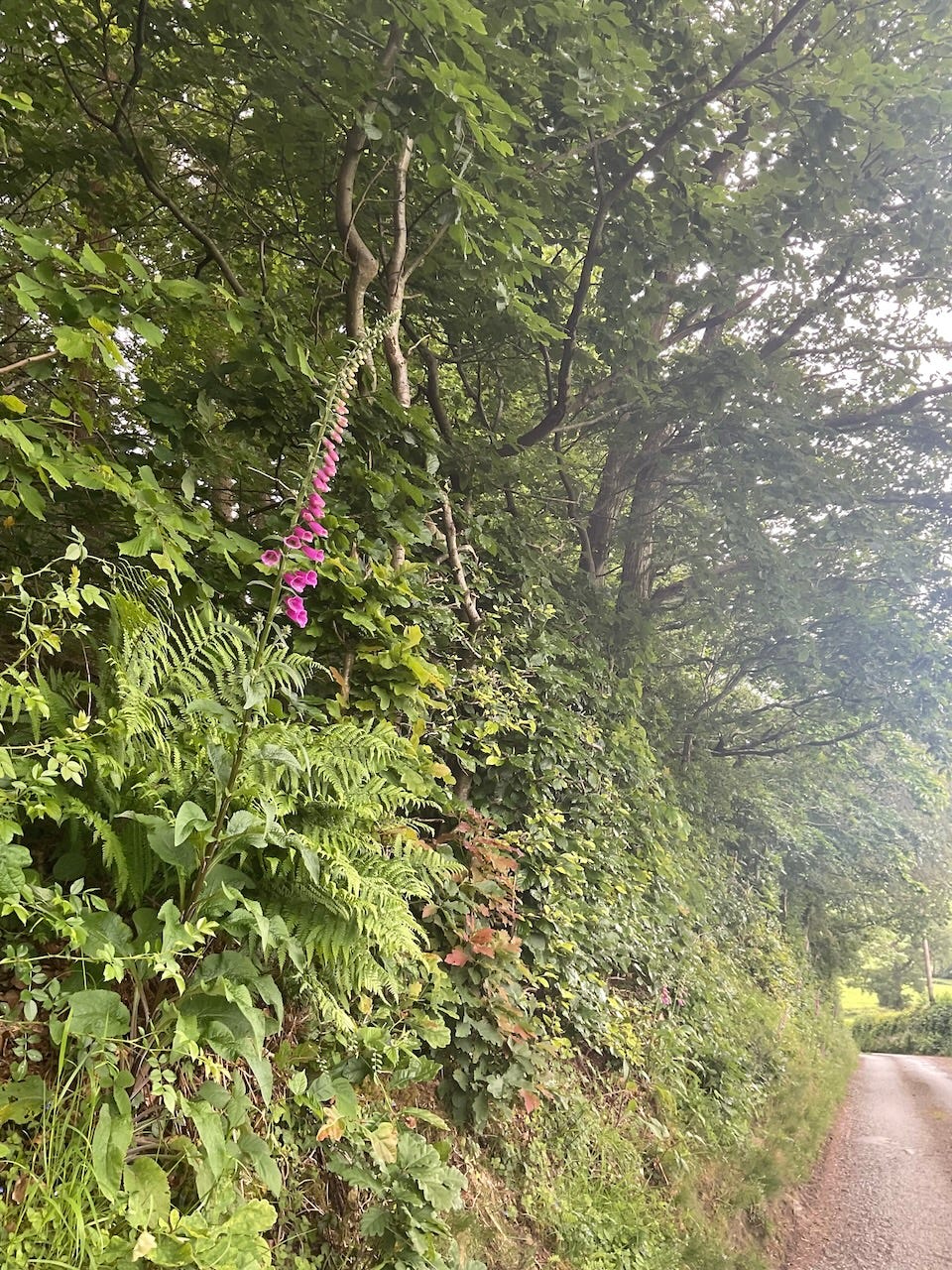
Ferns and foxgloves. Copyright the author, 2025. All rights reserved.
Up a hill, down the hill, around the base of another hill... I pass through a hamlet of a few houses... one is called ‘Sycharth’... along the road running besides the Cynllaith river... and there it is: the earthen double mound where once stood Owain Glyndŵr’s residence, the mansion of Sycharth. It’s on a rise above the river, offering views of the valley, and of the land that opens up to the north and north-west. A near-vertical slope shields the eastern approach, heavily forested these days. I climb to the top, sit down to enjoy the panorama, and devour the sandwich lunch provided by Michael at the B&B.
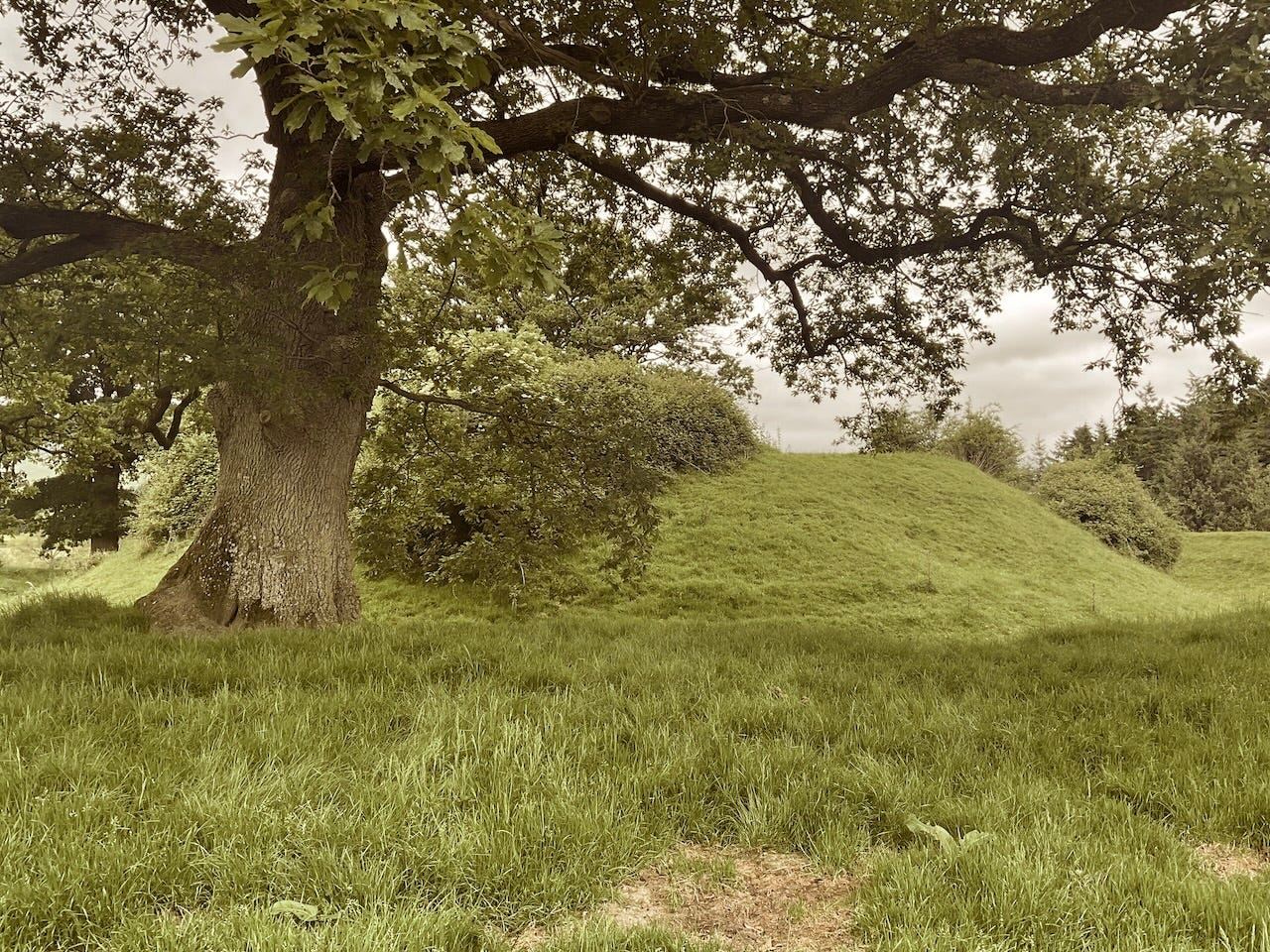
Sycharth. Copyright the author, 2025. All rights reserved.
This was where Glyndŵr resided with his family and servants, his largesse drawing the finest poets of Wales to his hall. It had chimneys, and tiled rooftops, and all the luxuries one would expect of a Welsh nobleman of proud heritage and distinguished royal service. It was a place of ease and comfort, of culture and leisure. Peacocks and peahens lived in the grounds. During the rebellion, it was burned to the ground by the king’s son, the future Henry V.
I linger. It’s a peaceful place. The weather is pleasant. There’s little to be heard beyond the birds. I can see why Glyndŵr liked it.
A Glimpse of Annwn
Eventually, though, the time comes when I need to move on. I take a different route, continuing north towards Llansilin, then eastwards before I get there. Up a steep, winding hillside road, its tarmac crumbling and potholed. Before reaching the top, the road switches sharply back on itself. I pause for breath, and look back west - and to my astonishment, I see clearly the great black bulk of Cadair Idris, the perilous mountain haunt of the master of the Otherworld, the lord of untamed nature, the mist-dwelling astronomer, Gwyn ap Nudd, looming behind the ridgelines of nearer hills.
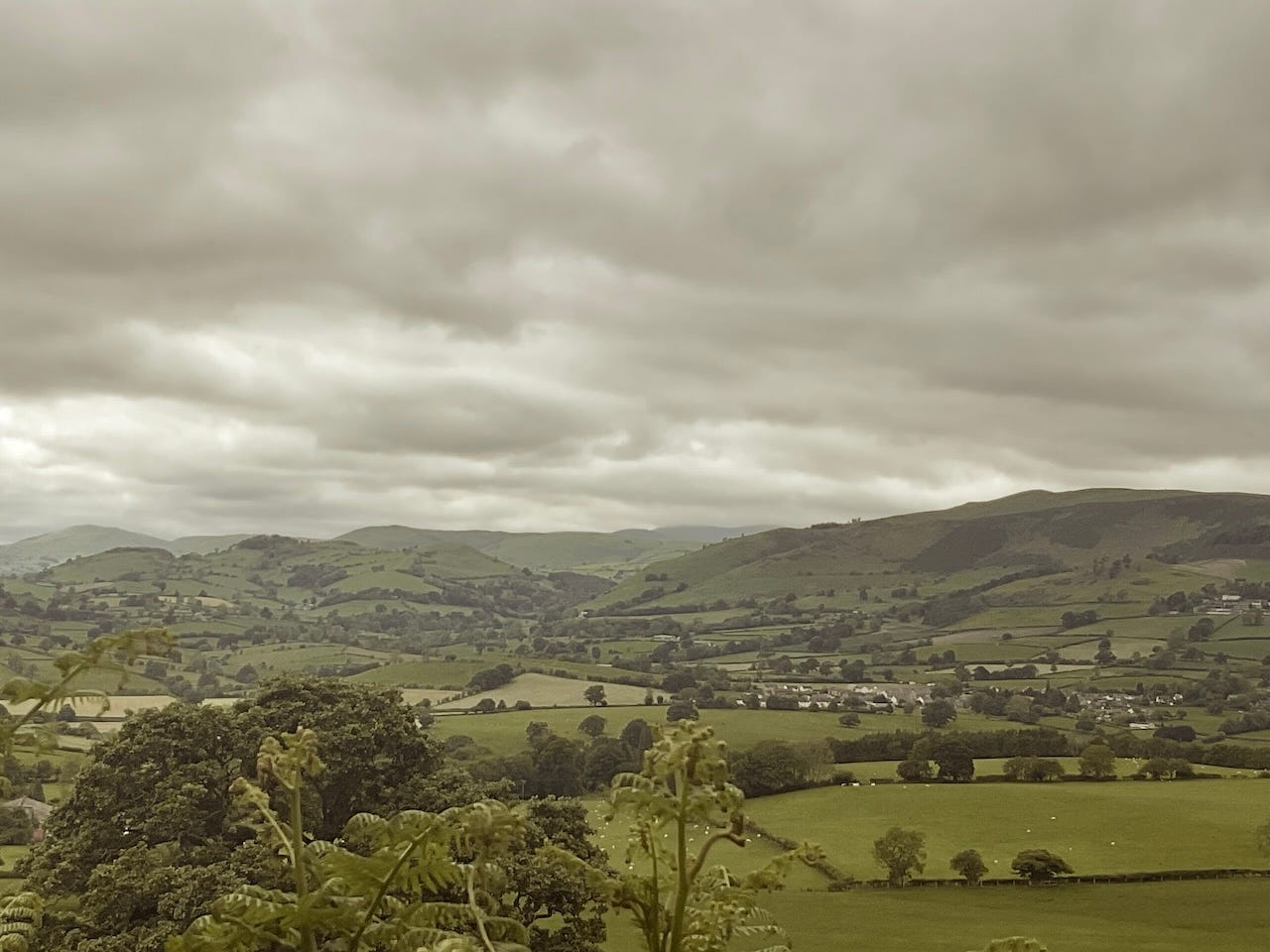
Cadair Idris in the distance. Copyright the author, 2025. All rights reserved.
I’m on the far eastern edge of Wales: in fact, I’m actually in England now, despite the Welsh names around me. Of course, in Glyndŵr’s day, it was all part of the March. Cadair Idris is on the far west of Wales - but of course, Wales is narrow here at its waist. Even so, it simply hadn’t ever occurred to me that this mountain of magic would be part of Glyndŵr’s daily psychogeography - but now I know that it was.
The Omphalos of Wales
Sycharth takes on new meaning for me. It feels suddenly like a central hub of Glyndŵr’s lineages. From this hilltop, Deheubarth, Gwynedd and of course Powys all seem to converge on this one spot. It’s the omphalos of Wales: the sacred navel of honoured ancestry, traditional kingship, and Annwn, the Otherworld, overlapping and revolving around the same central point.
I shudder, and still myself for a while. The clouds race overhead, the wind moves amongst the leaves. The brilliance of the sea-reflected light to the west glares in the heavens. I see no wonders, I hear no mystical voices. I can simply absorb the power of the land, the memories and energies of the earth, that stretch back through the lives of all who have lived here and made it Wales.
Then I stretch out my complaining legs and make the rest of the ascent.
After that, it’s downhill to the Shropshire plain. The landscape is undramatic; it’s a rich and comfortable land. There are hamlets and farmhouses, and the understanding that once again I’m in the land governed by the cycle of the seasons and the rituals of crops and harvests.
Closing the Circle
Then I’m on the flatlands and the long, unremarkable hike back to Oswestry. I offer a prayer of thanks to whichever local council has kept the pedestrian pavement beside this busy road in existence and in good repair.
In due course, I enter the town from the south-east and am once again flopped onto a bench in the Fox, backpack and hazel walking stick resting safely next to me.
After two failed attempts, I had expected that successfully reaching Sycharth would have moved me more. In fact, it felt almost pedestrian. I think, in fact, that this means I was ready to learn what I needed. This is what Sycharth meant to Iolo Goch and all of the other poets who journeyed there sought; it’s what Glyndŵr and his family made it. Sycharth was a place of welcome and repose; it was a place to be comfortable and savour life’s good things. It was a place to grow, to plant seed and harvest crops; to hunt the excess game and take pleasure in the peacocks’ display.
This is what Glyndŵr thought he would enjoy to the last, and pass on to his heirs. Instead, it was all snatched away in clap of thunder, when a letter was withheld and his world smashed asunder. He might have yielded, and fallen into darkness in ignominy. Instead, he rose to the moment, aroused his nation and left a national legacy of pride, identity and defiance in the face of overwhelming force.
It’s more than most of us will manage. Certainly, it’s far more than I would ever be capable of achieving - but then I’m not a wealthy aristocrat, heir to three kingdoms. But every one of us can consider how we would respond if the lightning bolt struck us, our Tower shuddered and fell, and we had to emerge from the ruins and ask... what do I do now? Who am I, when all that I knew and thought I was has crumbled and passed away?
It’s an insight that was worth the wait.